24 mars 2021 à 9:00 (HAE – heure de Montréal)
13:00 PM heure de Londres
14:00 PM heure de Paris et de Bruxelles
12:00 AM heure de Sydney et de Melbourne (pour les couche-tard !)
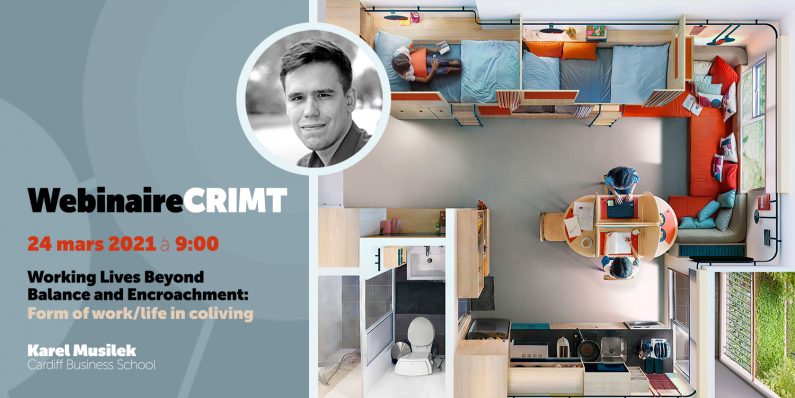
Working Lives Beyond Balance and Encroachment: Form of work/life in coliving
Le mercredi 24 mars prochain, le Partenariat du CRIMT sur l’expérimentation institutionnelle et l’amélioration du travail et son Comité étudiant, lequel a pris l’initiative d’organiser une série de séminaires sur le travail, la vie personnelle et leur équilibre dans le contexte de la Covid-19, vous invitent à plonger dans une exploration de la récente résurgence des arrangements de cohabitation et de partage d’espaces de travail (le coliving) avec Karel Musilek, professeur à la Cardiff Business School. À travers une étude ethnographique singulière, l’auteur se penche sur la relation entre le travail et la vie dans les arrangements de cohabitation, et sur la manière dont ces expériences cherchent à aménager la vie domestique et personnelle en fonction des exigences d’un travail extensif et intensif et des idéaux de réussite professionnelle et entrepreneuriale.
Intitulé Working Lives Beyond Balance and Encroachment: Form of work/life in coliving, le séminaire débutera à 9h00, heure de Montréal (heure avancée, ce qui se traduit, le 24 mars, par 13h00, heure de Londres, 14h00, heure de Paris et de Bruxelles et la fin de soirée à Melbourne et Sydney) et se déroulera sur Teams. Daniel Nicholson, membre du Comité étudiant, en assurera la présidence. La présentation principale sera en anglais, mais il sera possible pour ceux qui le souhaitent de poser des questions en français via la fonction de clavardage (lesquelles seront ensuite traduites pour le public et le présentateur).
La participation à cette activité est gratuite, mais nécessite une inscription. Un lien vers le webinaire sera fourni aux participants inscrits quelques jours avant l’événement.
Résumé de la présentation
Nous plaidons, dans cette présentation, pour un renouvellement des discussions sociologiques sur la vie professionnelle et économique. La recherche dans ce domaine a eu tendance à se concentrer sur les questions d’équilibre entre vie professionnelle et vie privée et sur l’empiétement du travail sur la vie non professionnelle. Bien que ces recherches soient éclairantes, elles ne reflètent pas toujours la transformation des pratiques et des arrangements sociomatériels de la vie professionnelle. Pourtant, nous suggérons que c’est, entre autres, dans ces pratiques et arrangements que l’extensification et l’intensification du travail sont prises en compte et reproduites. Pour commencer à combler cette lacune, nous nous appuyons sur la notion de “formes de vie” et l’élargissons pour conceptualiser la vie professionnelle, la façon dont elle est façonnée ainsi que les pratiques et les dispositions sociales qui la soutiennent. Nous explorons cette question à travers une étude ethnographique du ‘coliving’ – un nouveau mode de vie et un nouveau site d’investigation sociologique – qui cherche à modifier la vie domestique et personnelle en fonction des exigences d’un travail omniprésent et intensif et des idéaux de réussite professionnelle et entrepreneuriale. Nos conclusions montrent comment ce modèle est reproduit en maintenant une conception éthique particulière de la vie professionnelle et personnelle, en promettant une socialisation facilement accessible et en réorganisant les pratiques de la vie quotidienne. La compréhension de ces changements à travers le prisme des formes de vie peut nous aider non seulement à comprendre comment les vies sont transformées et modifiées afin de soutenir les changements dans le travail, mais aussi à saisir quels sont les arrangements qui maintiennent ces vies dans une forme intensive et exploitable.
Karel Musilek est un sociologue du travail et de la vie économique. Il puise dans les théories sociologiques et des organisations pour interroger la manière dont la vie humaine est façonnée par les sociétés capitalistes, sur ce que la vie est censée être et sur la manière dont elle est maintenue dans sa forme “productive”. Il explore comment les individus sont compris et se comprennent eux-mêmes, quelles pratiques ils utilisent pour soutenir leur vie professionnelle et économique, et quels sont les coûts associés aux pressions sociales, économiques et organisationnelles contemporaines. Toutes ces questions ont une forte dimension éthique et sont liées à la question de savoir ce qu’est une vie digne d’être vécue.
Il est spécialiste de la gestion, de l’emploi et des organisations à la Cardiff Business School. Avant de rejoindre l’Université de Cardiff, il a obtenu un doctorat en sociologie à l’Université de Durham, un certificat en méthodes de recherche sociale, également à l’Université de Durham et un MSc en sociologie politique de la London School of Economics and Political Science.